Research Themes
Lightning and Wildfires
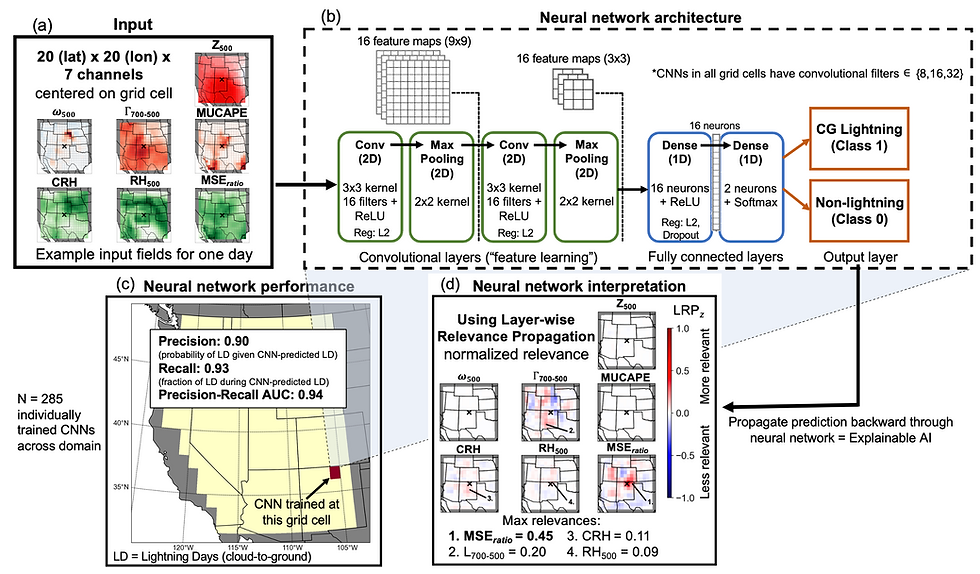
Lightning is a major source of wildfire ignition in the western United States. My research examines the meteorological drivers and environmental conditions that produce lightning and control whether it ignites a wildfire, with a particular focus on "dry" lightning. My research has characterized the atmospheric patterns associated with dry lightning outbreaks, quantified how precipitation amounts and environmental conditions influence whether lightning starts a wildfire, and shown that commonly used definitions of dry lightning do not fully capture ignition risk across different landscapes. I have also developed neural network-based machine learning models that predict cloud-to-ground lightning from large-scale atmospheric variables, allowing lightning to be quantified in climate model simulations where it is not directly resolved. Applying these models to future climate projections shows increasing lightning activity across much of the western United States and more frequent overlap between lightning and conditions favorable for wildfire ignition. Overall, my research aims to improve our understanding and prediction of lightning-ignited wildfire risk from individual storms to broader climatological shifts due to future climate change.

(top) Convolutional Neural Network (CNN) architecture used to predict lightning occurrence and (bottom) future projections of lightning days and lightning-ignited wildfire risk, obtained from applying CNN prediction models to CESM2
Publications:
Kalashnikov et al. 2025 (Earth's Future)
Kalashnikov et al. 2024 (JGR: Atmospheres)
Kalashnikov et al. 2022 (Env. Res.: Climate)
Kalashnikov et al. 2020 (J. Climate)
Other wildfire publications:
Kalashnikov et al. 2026 (Science Advances)
Kalashnikov et al. 2023 (6th OR Clim. Assess.)
Kalashnikov et al. 2022 (Science Advances)
Swain et al. 2023 (Comms. Earth & Env.)
Touma et al. 2022 (Science Advances)
"The Conversation" article: How heat waves increase wildfire risk

(top) Quantifying trends in annual-maximum hourly precipitation intensity at western U.S. stations and (bottom) matching hourly station-level precipitation extremes to tropical cyclones via atmospheric river objects

Precipitation Extremes
Short-duration precipitation extremes can produce flash floods, debris flows, and other hazards that threaten communities and infrastructure, but their physical drivers and trends are not well quantified. My research examines when, where, and why extreme precipitation occurs, with a particular focus on subdaily extremes and the atmospheric conditions that produce them. This can improve our understanding of evolving flood risk and other hydrologic hazards in an era of intensifying precipitation extremes. My recent work has documented an intensification of subdaily precipitation extremes across the western United States since 2000 and explored how changes in thermodynamic conditions may be contributing to these trends. I also investigated the weather systems responsible for extreme hourly precipitation, including tropical cyclones and cutoff lows, and how their influence can extend far beyond the regions where they originate. In ongoing work, I am studying how the intensity of thunderstorm precipitation is changing in the western U.S. and the physical drivers behind these trends, with important implications for both flash flooding and wildfire ignition.
Other precipitation publications:
Abatzoglou & Kalashnikov 2026 (Env. Res.: Climate)
Touma et al. 2022 (Science Advances)

(top) Quantifying the contributions of high pressure ridge strength, low soil moisture, and long-term warming to an extreme heat wave over Mexico/Texas and (bottom) heat wave trends over the western U.S. during 2001-2024

Heat Extremes
Heatwaves are becoming more frequent and intense with climate change, with consequences that can extend across physical, natural, and human systems. My research examines the physical processes that drive extreme heat and how heatwaves can amplify other hazards. In a recent study, I investigated the record-breaking June 2023 Mexico-Texas heatwave, showing how persistent atmospheric ridging and unusually dry soils combined to intensify the event, with land-atmosphere feedbacks playing an important role in its exceptional severity. I have also examined how heatwaves influence wildfire activity across the western United States, finding that a disproportionate amount of burned area occurs during and immediately following heatwaves and that heatwaves can promote both wildfire occurrence and growth. By disentangling the role of atmospheric and land-surface processes that produce extreme heat and its connections to other hazards, my research aims to expand the body of literature documenting the growing role of heatwaves and their impacts in a warming climate.
Other heat-related publications: